| |
 |
This chapter by Douglas H. Harris and V. Alan Spiker in the 2012 InTech book, Ergonomics: A Sytems Approach provides a model of critical thinking sufficiently specific to enhance understanding and to permit empirical testing. The model can, and has been, used to make testable predictions about the factors that influence critical thinking and about the associated consequences. It also identifies, describes and offers practical guidance to the development of training for the skills required for critical thinking in intelligence analysis.
In the last couple of decades a number of useful tools have been developed to support the
intelligence analysis process, encompassing the functions of data collection, evaluation, collation and
integration. However, intelligence analysis remains highly dependent on the cognitive capabilities, specifically the critical thinking skills, of the human analyst. For this reason, it is important for the success of the process to understand the inherent capabilities and limitations of the analyst and, in particular, the challenges that must be overcome through the design of analysis systems and in the training of critical thinking skills.
Download the Chapter
Email Doug Harris
|
 |
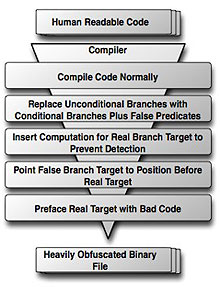 |
This white
paper describes a next-generation, software-protection technique
that prevents powerful, emerging tools for software reverse
engineering from successfully attacking compiled software to
expose underlying, human-readable code. The white paper is written
for software protection managers and software development professionals.
The paper:
- Presents the issues
- Describes the new, broad-spectrum protection technique
- Provides a proof-of-concept, next-generation, "heavy
obfuscation" compiler
- Identifies a strategy to protect national-interest software
Email
Bob Dick |
|
Click on the book to order from Amazon.com |
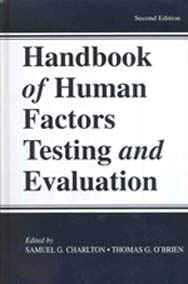
The second edition of
this handbook, edited by Samuel G. Charlton and Thomas G. O’Brien,
was published in 2002 by Lawrence Erlbaum Associates. It contains
the chapter, "Human Performance Testing," by Doug
Harris. Human factors testing and evaluation is the principal
means of assuring that systems and products will be effective
and usable before they are placed in the hands of operators
or users. In this second edition of this well-received book,
the coverage of human factors tools and techniques has been
updated and the application case studies and examples have been
expanded. In his chapter, Doug Harris provides a source of information
and guidance for the development and use of performance tests;
it is based on his experience in performance test design, administration,
analysis and evaluation. The chapter also encompasses the earlier
work of others in this area.
Email
Doug Harris |
|

Click on the picture to retrieve this report in PDF format
|
A study for NASA to
identify behavioral issues associated with long duration isolation
and confinement at the French Antarctic base at Dumont d’Urville
and at remote duty stations in the Indian Ocean.
Email
Jack Stuster |
|

Click on the book to order from Amazon.com
|
Based on 15 years of
research for NASA and the Department of Defense, the book identifies
the principles of habitability and presents more than 200 specific
recommendations to facilitate human adjustment and performance
under conditions of isolation and confinement. The recommendations
focus on the design of space craft and space habitats, and the
operation of long duration space expeditions, but they also
apply to shorter missions, and to a variety of Earth-bound conditions.
The research involved the study of conditions on Earth, such
as submarines, Antarctic stations, polar expeditions, and voyages
of discovery, that are comparable in important ways to what
might be expected for future long duration space missions.
Email
Jack Stuster |
|
Click on the book to order from Amazon.com
|
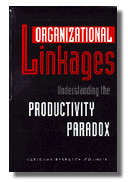
Authored by a panel
of the National Research Council and edited by Doug Harris,
chair of the panel, the book is now in its second printing.
The book examines the conditions under which improvements in
individual performance are, and are not, realized at higher
levels in an organization, focusing specifically on individual
and organizational productivity. Theoretical issues and measurement
problems are addressed, and in-depth examinations of organizational
linkages in office automation, computer-aided design, and software
engineering are presented.
Email
Doug Harris |
|
|


